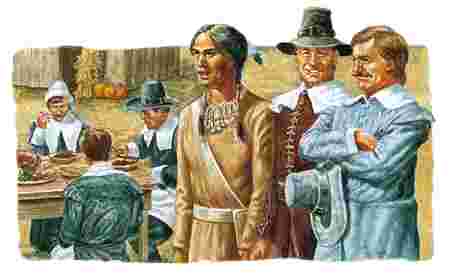
Feast of Saint Tisquantum

sq

It has only been a few months since my last post. Time to send the silence to its reckoning. More to come…

The Feast of Saint Tisquantum
as recollected from the glossy truths of American textbooks

Save his naked ghost a seat at your table amongst the cornucopia of roots and gooseberries
and the meat of musket shot. Commence with grace for the long-haired holy diplomat

and cultural chameleon. Remember the Wampanoag coast of rock and crash where black-suited exiles with buckled hats unloaded unprepared. Their seeds were not for this land, the fauna too

phenomenal. Their pilgrim hands unaccustomed to the labor of survival. Roanoke
then comes to mind, marooned and wasting away in colony. Imagine the Powhatans and

Tuscaroras watching from afar, patient for the sky to fall. Because white men had never come

to stay (!), they did not reach out. The exploration stalled and starved. Legend of colonial ruin traded north, up the coast in economy with shell and bead to the juts and boulders

of Tisquantum’s edge of the world where he was legend himself; tales twisted tall
of streets (streets!), ships, deities, slavery, his bilingual tongue. The clothing covered his legs

all year round, he thought the educated conjures of a salvaged savage who knew God
to be loving and just and warm. His soul had been saved (saved!). Only when he had returned

from the exotic longitudes of Malaga and London, his people had been decimated by bacteria.
As the pilgrims landed, psalmed, suffered and wavered, he did not tirade or shake the war rattle (!).

He taught them viable crops and fertilizers for a flourishing. In their quest to find God’s many faces
within forest apparitions, the bounty of New World anarchy, of Indian and frontier,

Squanto was a docent of wilderness. __ __ __ __ __ __ __ And in the end thanks was given for a harvest
and togetherness. God was present on the shoulders of his saint. Give thanks unto him,

patron saint of squash blossoms and potlucks. The rest are simple footnotes
and iniquitous blemishes (!) to be misremembered or forgotten. But not the doted Patuxet,

this salvaged species, there is responsibility at every table to revere the naked ghost,
rightly stripped to a favorable likeness for the voracious cavalcade of football and feast.

The Graduation of Heroes

Vista Grande Class of 2013

It is easy to teach my students the basic elements for the art of storytelling. The beginnings, the middle, end. All stories derive from this stem.  The conflicts. The resolutions. The characters. It is accessible because the students can find themselves as a character on the continuum. Oh, I see Ned! So it’s like when my stepmother moved in, when the berating, beating and alcoholism began and when my father finally manned up and got his second divorce. Sadly, yes. Oh, or like when I realized my father left with no one knowing his name, when I found out I am not a registered member of my tribe because of this and when I committed myself to anger and depression.

Of course, these students never actually speak up like this. But I can see their wheels turning. But I know when I ask them to connect their learning to their own life, a critical element of transference at our school, I am likely opening a recently healed wound or adding the salt as most teachers unknowingly do. Most students have experienced trauma at some point of their lives before they set foot in my classroom.

A bit of perspective for this is a tale my aunt told me. My cousin was in fourth grade and his parents were seemingly happily married. His peers, at least the majority of them, were from the often mislabeled ‘broken home’. He innocently asked his mother, why aren’t you and daddy divorced? Why are we different? The confronting of such childhood tragedies is not uncommon. In fact living in a household with two parents led my cousin to question why his family was an outlier. To note, they have since divorced and now my cousin can add foreshadowing to his understanding of how a story is told.

I have been trained to know that something so commonplace, such as divorce or parental estrangement, can give a child Post Traumatic Stress Disorder. We see this played out in our schools and doctors offices and prisons each day. Young people misplaced, misled and misdiagnosed.

So I decided to help them write their way through their drama. We teach our students to introspect slowly over the four years they attend Vista Grande. And in doing so we hope they graduate as a somewhat realized individual. By their senior year, a Vista Grande should be able to communicate at a highly mature level with people of all ages and background on a variety of topics. They understand the politics of education. The culture of borders in our community and abroad. The opportunities for sustainability in Taos County. The consequences of mining our planet for consumer products and energy and monkeywrenching that system. The power of their voice when they see themselves as experts on the nature of substance abuse and dependence in our community.

But most importantly they know themselves. With the help of existing curriculum before I taught Senior English and the unique study of Plato’s Apology from Codman Academy in Boston, I have created space for my students to envision their life as a path and themselves as the author of their story.

For two years I have been teaching students about Joseph Campbell and the Hero’s Journey. We talk about what the word journey means. We envision ourselves as heroes called to fulfill our destiny. We know there will be descents into darkness and aid from the people we would least expect it. There may be fear, missteps, deceit and tragedy. But we learn, on this journey, in this life, we have immense worth and power. We are meant for something. And anything that has occurred in our lives, whether it is from our doing or an instance outside our control, can be used to transform us.

By studying Ancient Greece and the Trial of Socrates, we know there will come a time when our truth will be questioned. When the cosmos conspire and the spotlight is on us. We are called to defend ourselves. How we have acted. Why we have hid. What our scars represent. Eventually we must answer for who we are. For why we love how and what we love. For why we would have the courage to corrupt the youth and help them shape their stories.

So my students answer the writing prompt: What has made you who you are today? Who is responsible for this human being before us today? Where are you headed? What darkness have you seen? What light have you fought like hell to keep shining? What demons are still at your throat? What heroic powers do the next classes of Vista Grande students need to make it out of teenage hood alive?

If this were the only class I taught, I would be an eternally fulfilled teacher. I have received songs of joy. The litanies of regret. The poetics of young love. The chaos of substance abuse. The passions of murder. The cold eye of distrust. The childhood bruises of fear and the resilient healing. So many stories to carry with me. This should be mandated curriculum for all high school seniors.

These students have become my teachers in what it means to be a hero. The retelling of a girlfriend witnessing her boyfriend shot and killed. Her struggle to realize she should not have joined him in death. That he will forever be her story. Her strength aided by grief groups and counseling. Her commitment to love in all its crushing absence. She is a hero.

Or the young girl passed between foster families and her journey of self-acceptance. The orphan boy who learned to trust and then love his adoptive father. The sixteen year old on the path toward drug addiction empowered to get clean despite the withdraw and trauma of drug related loss. The Pueblo boy caught between two worlds that, like his elders, leaves wisdom in what has not been said.

This process of owning their stories through writing them is the most beautiful accomplishment I have made as a teacher thus far. They have turned personal tragedy and trauma into strength. They are my heroes.

The tragedy of teaching, in this context for me, is the yearly release of these young people. Those whom I have come to love now walk away. My participation in their formative years has ended. They are closing chapters. They are scripting fresh beginnings. All ready and emboldened to live their life as a journey.

And teaching is the greatest instructor of humility. Ultimately, they are ready for something greater than myself. I can bear that happily. Though the sadness is not knowing whether I will ever learn of their heroism again.

Good luck to the 2013 graduating class of Vista Grande High School. I love you and you will be missed!

(additional reading for all teachers…Will My Name Be Shouted Out by Stephen O’Connor)

Send an Artist Back to School!

I had some students help me create a video for a fundraising campaign. We are hoping to create something of an artist-in-residence program at Taos, but with multiple art classes happening every Friday afternoon for ALL students! We are trying to raise 30,000 American Dollars to help compensate the artists for their time.

This could be a once in a lifetime experience for many of these students! Check out or video and SHARE SHARE SHARE!

VGHS Red Capes Pitch

The Summer of Combustion

We had an inexplicable day off from school today. Taos was also blessed with an afternoon of intermittent rain. We are hoping for a coming season of reliable precipitation for our water, our food, our peace of mind. The wish is unlikely in an era of mega drought. But today, there was hope. Today I offer a poem written during the summer of 2011 when New Mexico experienced a dreadful season of wildfires.

I am also inspired to write and refine my poetry by the Taos Tygers Poetry Team and the upcoming Taos Poetry Festival. I love May!

Enjoy The Summer of Combustion:

This is the summer of burned Santos and fear of prayer.
People drinking water from dog dishes and coughing
fits of flu. This is the summer of restless
teethclenched sleep and poetry blight.
The summer of wandering the riverbank
finding coyote carcasses
washed from eddies of molybdenum and gold.

The summer of learning how to make love
not be love. It is not the season for love
letters boxes of chocolates and dedications. Instead it’s hands
on hamstrings man and woman
panting. Swallow each other
whole. Shared
art of body blessed blood
and sweat. This is the summer of pregnancy.

Pocketknives in trailer parks. Dead end
murders in Tres Piedres. Cocaine run
petty happiness. Mas muertes. Prison
construction. Cell after cell after cell after
scarring abuela with the edges of bandanas.
Banderas at the bodega
resetting property lines with New Atzlan land grants.
Tú ganas nunca.
Qué viva Tierra Amarilla.
The spark of war.

This is the summer of choosing sides.
The stray dogs staring at you while they shit
Like which one of us is civilized?
Low altitude military osprey flyovers
bombs dropped from NORAD drones
the War Chiefs petitioning the FAA
for clear skies during sacred times.

This is the summer of never flying again. Throwing
frisbees with children. See them smiling
something defying gravity
one hundred feet at a time. Smiling
stuck in dusty hot rattlesnake gravel pits.
They are happy simply playing with wind
plastic and chains.

this is the summer of combustion
forests up in smoke
carrying our prayers
our condemnation
sixty seven percent contained
five hundred thousand acres
hotshots whack-a-mole the national forest
trenches
ten percent contained
twenty thousand acres
engines
embers carried on sixty mile per hour gusts
forty thousand acres a day
no rain for a moon cycle
downed power lines sparking
smokejumpers
contained the mountain sangha
the land of creation stories
the bands of refugees in gymnasiums
contained
weapons grade nuclear waste
the wild west
this inferno
unrestrained

Earth mishmashing with spirit
tangled and piping hot.
Headwaters tapped bone dry.
Evaporated dams steaming. The lost source
the lost supply. Too many
found the bridge
toed the railing
and tested their wings. Too many
shooting stars
and not enough wishes.
This is the summer of rampage.

Gang Awareness and Common Core State Standards Trainings

I wrote this piece almost two months ago after a February 23 day of training. That day I was working, but I didn’t see any students. Two trainings, nine hours. Today I attended the second session of this four day Common Core professional development. Enjoy the read. Remember, I love my job. I love the challenge. I hope you find the humor in my writing because I really enjoy sharing. I also hope you find something to think about and discuss in your circles. Share away.

When I enrolled at Salisbury University, I figured to graduate with a degree in secondary education and history. Just like I had told everyone in high school. Just like my picture assumed next to the yearbook caption: “Most Likely to Become a High School Teacher.” Sadly, I felt the sails wrinkle and deflate with my student teaching experience. The department head at Wicomico Middle School had one piece of advice for a promising young pupil. Don’t go into teaching. The testing requirements are handcuffs and the students are, increasingly, a mess. Today, ten years later, dude was right. And no matter how much he deserves me hunting him down and telling him he forgot his asshole card at his retirement party, I think of him too often. Especially during a cold February Monday when completely removed from the classroom, I am drowning in professional development to meet the challenges of both student and assessment.

It’s impossible. The embryonic stage of Standardized Testing as curriculum is over. The gargantuan love child of education capitalists and distant politicians is teething and learning how to walk. Unlike my experiences within the Expeditionary Learning network, Profession Development is always a bit of a passive process for most educators led by state employees who have been trained by curriculum hucksters. Common Core State Standards seems like an effort to stimulate the economy with tech support, bureaucratic positions, testing coordinators, textbook salespeople, evaluators, brainstormers, legalese consultants, analysts, and unicorn breeders (anything but more teachers) as much as it seems a genuine effort to help American children close the achievement gap.

This day, I learned how to invest in these Common Core paradigm shifts. The quantifiable gains (of which, if implemented in perfect harmony with unprecedented rises in student motivation, caloric intake at breakfast, and reading levels) may be seen in five years. The average teacher, by this time, will either be pursuing a more lucrative career or perhaps grasping for the placebo of merit based pay tied directly to the impending dip of test scores due to the increasing rigor of CCSS tests. Further reading: http://www.teacherintherye.com/the-common-core-state-standards-are-setting-schools-up-to-fail/

Yet there I sat, learning of the intended increase of challenging texts my students will be forced to grapple with. I do accept this as a challenge. I will motivate my students to beat the man, as we say at VGHS. But this training does not help me grapple with students who are at risk of alcoholism as 14 year olds. Children born of the cauldron of domestic abuse. Children of rape. Children of the addicted, or mentally disabled. Children of IQs below the median temperature of a Santa Fe summer day. Children of no glasses, no showers, no fathers. The majority of my students come to me comprehending below Middle School reading levels. We are talking about 16 year old freshmen who are more adept with wielding a spray can, a blunt or hand gun than a pencil.

Eventually the training ended. Now equipped with new tools to help my students achieve their academic horizons, I headed not home, but to VGHS to attend a training about Gang Violence and our ‘population’. I hate that term. When I say it, I fear my participation in the school to prison pipeline. I am desensitizing myself to the lives and personalities I pledge to honor. I fear I am ready to become a bureaucrat pencil pusher who used to teach. I fear I have cemented my path to head the Wicomico MS History Dept.

But our population is threatened. 20% of our school is gang affiliated or intrigued by the lifestyle. Every year we have had members of Brew Town, Surreno, Northside, whatever, come to Vista. And in the past these students, despite strength in numbers, have weeded themselves out (again, I hate my way of naming). They drop out or go away. This year, each neighborhood gang is well represented and, somehow, getting along swimmingly. Everyone is happy together talking about Red parties, Blue parties, fights, drugs, and how life would be easier for us teachers if we politely, collectively, decided to fuck off and leave them alone.

Every day is a battle of wills. How far do our rules stretch? How many times will that teacher ask me to do work before I don’t have to ever be asked again? How many people can I intimidate into submission, silence, or respect? How brazenly can I defy gravity with my pressed khakis below my hips? What is the perfect balance of absenteeism and passivity one can strike before a truancy report is made?

This is learned behavior. The families are dealers. Getting ranked in can be a birth right. Perhaps some of these youngsters are the products of overmatched parents or grandparents. The cultures of violence, bigotry, misogyny, class struggle, identity, and addiction are well rooted in Taos.

The fact of the matter, in order to address the burgeoning gang influence in our student body, we need to recognize we are up against a familial structure that is a pillar of the town and Taos culture. No matter how shambled the edifice upheld by this pillar. And quite, luckily, the kids are getting along. They enjoy each other’s company. They enjoy wreaking havoc on our school culture. Knocking back a few airline bottles of liquor at lunch. We are simply seeing a generational decay of drug use, affiliation and addiction play out in a handful of students.

The depressing part of our battle for minds is the fact these people are cool enough to garner admiration from almost anyone in the school. The lifestyle choice of illiteracy over education and any general sense of citizenship is winning. That says as much about our school as it does the town, the age group, the economy, the media, the country. The challenge waits daily for our faculty, most at wit’s end and ready to let it all go (read it as: the profession, the calling, the youth). Yet our students, show up. They receive as much positive reinforcement of their potential as we can muster. They are supported as young people. Our school is more the symptom of a greater affliction. But we are the organization faced with the consequences. Watch these kids. Ride them into the ground. Raise the test scores. Get them to graduate.

And in leaving school for the day, I was reminded that every color of the rainbow is affiliated with some street gang. Mexican Mafiosos are now in Taos. Everybody has a nickname, tag, tat, gat, shoelace and swag. And I am responsible for the clowns graduating from circus school. Appendages, credits, test scores and all. Good luck!

Tightroping Motivation

I have been toying with writing about my life as a teacher for some time. Prior to the censored poetry issue, I was already on my way penning drafts of essays and poems. I am ready to release them into the ether. Here’s one about purpose, motivation and leading with the heart.

People need to find and understand the purpose of what they are trying to accomplish. And students today have, arguably, lost their purpose. What’s next after high school? Anything reliable? Anything definite? No? Well, then what is the point?

As a teacher you have to find ways of motivating your students. You can be sincere and thoughtful. Matter of fact. Prodding and pleading with Jeremiads. Heartfelt and empathetic. Or you can be blunt and borderline mean. But your personality and approach far outweighs the message sometimes. So how do we create students who are on fire about education?

Thankfully there is a boatload of purpose embedded in our Expeditionary Learning curriculum. We study Border Issues and interview members of Taos about cultural divides lingering in our town since colonialism, both Spanish and American. We ask ourselves of community needs and argue publicly for those needs with editorials. We learn of the heroic journey, and Plato’s account of Socrates’ reasoning for his life, and write our own apologies. This is stake in our studies. There is purpose. Once that line is blurred or forgotten, the students are remiss in the duty of learning. As if there needed to be something more than the simple act of learning.

For many, the topic of our Expedition is a moot point. Students may never buy in. They may never do an ounce of work outside the building. But with Expeditionary Learning there must be a need to know. More than desire. A burning, on a Maslovian level. My future depends, somehow, on this learning. I need to know how to build soil, how to introspect, how to spend my money as a consumer, what messages or affirmations or cries for help I can embed in my art. The skills of citizenship.

Pubescent teenagers rarely demonstrate this level of internal drive or pride in their work. For most teenagers, this is a time of fumbling around love, social awkwardness and acne. Dealing with off base parents. Scoring the next high. Few truly want to do good or make change. And so purpose is the push they need. Addressing community issues. Or building something bigger than themselves.

And as a young idealist, this was enough for me. If my students could achieve  within the context of my high stakes project experience, this accomplishment, often measured beyond the constructs of English class and the drudgery of school, was enough for me to deem them ready-for-life-after-high-school. I didn’t give work based upon rigorous reading comprehension or traditional assessments. Old school skill sets. My philosophical standpoint and world-view regarded these as antiquated, misinformed data points. I had of my students, and their world, more holistic views. More heart based. More human oriented.

But I was limiting them. I am not sure I bumped one student from not passing to proficient on the state tests with this approach. I would argue that most students who passed these tests could have done so with or without me as their teacher. Those students, in my first years, who couldn’t pass as a 9th grader, likely wouldn’t pass as an 11th grader. What I was teaching, although engaging, practical and important, was not in the traditional metrics of success. And whether Common Core State Standards is here to stay is not important. The tests open or close the doors. If they cannot pass the state tests, they are not passing the ACT. If they are not passing the ACT, I am not helping them entertain success in college, let alone enrollment.

But my practice was not being questioned. I am looked at as a senior member of our faculty. I am an Instructional Guide. I am sought after by my peers. I have been accepted as a Master Class presenter for Expeditionary Learning’s National Conference three times. I have been invited to share my curricular work with a national audience through Fund For Teachers and my two traveling Fellowships. But my kids don’t do homework. In fact, I rarely assign homework. I intend for rigorous in-class experiences and assignments. They very well may be. But my students are not making gains. Of course, I am not alone. Despite my accolades and the esteem my colleagues may hold for me, I am churning our students much like the rest of the state’s educators. Those students are unable to enter a college class beyond the remedial level. And students who enter college in remedial classes rarely have the wherewithal, motivation or support to graduate. Those who I am unleashing into the world with dreams may be rudely awakened without apology.

So I can encourage, plead, bargain, bend backward, massage, and finesse earning high marks, but I cannot ensure participation. Nor desire. And certainly not purpose. And in the past, this would be fine. Students could skirt by in high school towards a diploma and take a couple classes at UNM Taos without much consequence. But in this climate of testing, New Mexico is upping the ante for potential graduates. Trying to keep up nationally, if one cannot pass the tests as a Junior, the student may never earn a full high school diploma. Or they can demonstrate mastery on an End of Course Exam created at the state level. Essentially, can’t pass the test? Well, make sure you pass the highly correlative Final.  The access to a full high school diploma is all but fantasy for some students, if you were to ask them. The likelihood this will only result in more post secondary confusion and dropouts is certain. Oh, I cannot earn a diploma, and you have evidence of this by the time I am a freshman, but I can study for a few months and possibly earn a GED? Perfect. Bye!

Sometimes a teacher needs to be real. Too often we are not. The harsh realities of these tests, and the students’ disbelief in both their aptitude and the tests’ efficacy result in a complete malaise that becomes infectious. The culture of education is demeaned and learning loses value. School becomes a social event solely. Students’ negative view of world and self are reinforced. The teachers are left on lonely islands without purpose or meaningful appreciation. A life alone with only your shaky nerves and graying hair. Isn’t that the movies? Isn’t that the state of our education unions? Tenured and safe, but downtrodden? Too few exceptions.

So I tell my students about stereotypes. I tell them that the average reading level of an incoming VGHS student is the fifth grade. Those ill-equipped readers are likely to drop out. 80% of our student body qualifies for free and reduced lunches. They’re poor. Those students usually do not graduate. Hispanic males, Native American women, children from broken homes are not meant to go on and succeed in college. 4.0 for a student like you? Out of the question. Academic scholarships? Forget it. Likelihood of a job with benefits, paid vacation, retirement plan? Not on the horizon without your high school diploma. The numbers never lie. You aren’t going to do this and you most certainly aren’t going to do that. You aren’t smart enough for this school, you aren’t educated enough for this job.

All the stereotypes about my students are being fulfilled. The correlation between teen alcohol abuse and literacy. Check. The relation between skin color and graduation rates. Check. My students are smoking pot more often, I’d say three to four times as much, than they touch a book. My students are so hungover Monday morning my classroom’s florescent bulbs are still a bother Tuesday afternoon.

And so I say: You tell me how unfair it is to misjudge you. How many people limit your with their preconceived notions. Might you know why there are college in the Southwest with free tuition for college bound Native Americans? Or why UNM offers a lottery scholarship for graduating high school with a 3.0 pulse? No one thinks you’ll go! No one expects you to follow through and educate yourself! No one expects you to be anything more than a 20 year old mother. A deadbeat dad. Another drunk Indian. Another domestic abuser. Another statistic fulfilled. Another stereotype met to justify correlating literacy levels and available beds in prison. You are cementing the same stereotypes for your younger brothers and cousins. Your children. You are not besting or outsmarting the cruel world you perceive with your strategy of avoidance. You are succumbing! The only person establishing your future is yourself. But a statistic, or a stereotype, cannot make decisions.

And then there is either applause or awkward shifts in desks. Followed by sheepish questions trying to convince themselves, and more importantly me, that they are ready to get after it and give their best effort. For at least today’s lesson. I’ll do it for the Gipper this once.

But I would have to deliver this sermon weekly to keep the students lit. I cannot say mush. I must only show up. Ready to drop knowledge at any moment. But these speeches, or diatribes, or moments of sheer panic, depending on the audience, day, or mood, cannot be overused. I never get angry at a student publicly. I never raise my voice save once a year. These moments need to be unpredictable, unscripted and highly emotional. I find my voice quivering by the end. And I never know how a teenager will react when I tell them to prepare for a life of alcoholism. I believe this scenario could be an alternate future of the phrase don’t kill the messenger.

Bottom line. Motivating students in this day and age, in this town, is a tall order. I am happy to facilitate cool and innovative project models and bring opportunity into the classroom. I am also happy to not assign homework both for the rigor of my class time and the advocates it creates of my students. I don’t think anyone has told them before how hard it is going to be to defy stereotypes. I am not sure they know that anything intellectually grueling is worth a moment of their time. Few witness this at school. Fewer see this demonstrated at home.

Maybe it is all about setting a new purpose. A fresh target. Something they can all aim for. Something written in student-friendly language. An I can statement. Something to build self-efficacy:

I can defy my stereotype.

OK, class. Who can tell me what it means to defy.

Standardized Testing Poetry

Last week I had posted a brief collection of poetry that I thought was benign. Those poems, with references to the tests my students are tasked with mastering each spring, were removed at the encouragement from school administration. My poetry had jeopardized the validity of my students’ scores and asserted a dangerous point of view in terms of my professionalism and requirements of being a teacher in handling the sensitive test information.

I am mulling the decision to repost these poems and the consequences this act may have for my licensure. I believe the poems stand as a critique of our testing culture and the realities facing our students in this education paradigm. The fact these poems could be seen as a threat to my students’ scores or my professional integrity only reinforces the need for a look in the mirror with this testing climate we live in as educators and students. Can my poems, with direct correlation to the tests, really be so dangerous? Am I not allowed to critically think about my experiences as an educator and interpret them poetically? Do my words about tests and the frivolity of the tests outweigh my references to disillusioned youth, school massacres/murderers and the everyday grappling with apathy and boredom? I would think mentioning Klebold, Harris and Lanza would be more of an alarm than addressing testing issues.

As I try to personally come to a conclusion about these issues, I offer two more poems written form my experiences last week. In response to my poetry, I am no longer allowed to proctor tests at Vista Grande. That doesn’t mean I cannot critique and, more importantly, feel.

Grammar Teacher’s Doubt
Has the comma dislodged
from an isolated brain wrinkle
finding roots within the written response?

When I said run-on sentence
and they said huh?
did it matter how I responded?

If I were explaining poetry again
to a crowd of texters and tweeters
would they finally see themselves
as poets
creators of lines
affronters of language?

Do they remember what I have spoken
of their voice
that their song can move mountains
and today’s audience is aptitude?

Gaps Akin to Achievement
One exists with nutrition
the abyss between my students’ McDonald’s
and those students’ whole foods

There’s one with stability
the great equalizer is home
perhaps the heat, the divorce, the abuse

Purpose—the great unknown of growing old
and whether this test is any measure
of anything on which to rely moving forward

Standardized Testing Poetry

It was brought to my attention this morning that the poems I had posted last night after school needed to be removed from this blog. Expressing myself poetically from inspiration drawn from the testing experience compromises student scores on these exams. As well the validity and security of the test. Someone could have seen something sensitive to the integrity of the test within my poetics. I do not want to subject my students to more tests or standardized scrutiny. My poems were censored due to this issue. They will be reposted in April after the testing window closes.

-March 20, 6:15 pm

grace•ful•ly

Here’s a new poem for the beginning of my final week of uninhibited summer. This poem is in honor of a wonderful lady I am lucky enough to be getting to know. Very lucky. You’d be inspired as well, if you had the chance to shine due to her presence.

And then there is Dora McQuad, googled here. She is visiting State College, PA to participate in a part-celebration, part-media circus remaking how community heroes are enshrined. Her image has replaced the likeness of supersnakegrossmiscreant Jerry Sandusky of the formerly untouchable, untarnished Penn State football program. So I am also posting this poem in dedication to her. May she embark gracefully. The global attention surrounding her work is unprecedented, but worthy of such a writer and person. Her purpose emboldens quiet voices.

Enjoy.

grace•ful•ly

believing in the best possible world
wordsmiths added the suffix –ful
to grace
in order to prepare language for her arrival

they defined the sentiment as embodying beauty
taking hold of it in the veins
and beamed from the heart
in every gesture genuinely
sweetly

upon this they affixed the –ly
so to measure the elegance of her movement
in the way a soloist would an aria
or a master of brush her fresco

simple really
to appreciate this gradient of human light
like the aficionado can taste
but not press grapes

the challenge she presents the world
with her eyes encouraging in every gaze
with soft reassurance
that we too have strength
for grace in all possible abundance

that we may be seen
all living
so fully

Bringing the Changes in Belfast to Taos!

Alan Waite is a youth worker in the Shankill, where the parade took place last Saturday and the ominous mural of the gunman pointing his rifle right into your grill never sleeps.

He is a lifelong resident of the Shankill and knows the ins and outs of his community. The lies. The power structure. The reality for the youth. I learned of his work from the Interface Diaries, but his reach in the community does not stop there. The scope of his work is impressive and inspiring. What was meant to be a brief meeting at a coffee shop ended up as a three hour sharing of ideas, project models and curricular ideas to connect our students and augment each other’s work with young people.

I wanted to know about what the youth see as their future. He says it is bleak. Very much like my students, they react to their boredom with anti-social behavior. I love that phrase: anti-social behavior. The savvy and debate prone students of mine would argue that this type of behavior is quite social. Drugs and alcohol. Teen pregnancies. Paramilitary organizations (think the UVF and UDA) operating like street gangs. Sounds like a party atmosphere to most bored teens. And even if they can navigate this minefield, there are few long term employment opportunities for Belfast youth in any neighborhood. Alan’s mission, along the rest of the dedicated staff at Glencairn Youth Initiative, is to create opportunities for these young people to serve their community.

They have developed YWIC. Youth Workers in Communities. This initiative is made up of a three year cycle for young recruits. In year one, young people with leadership potential have been identified. In Alan’s eyes this doesn’t mean straight As, straight faced or straight laced. He’s actively seeking young people that are street savvy and hold sway with their peers. Most people call them rabble-rousers. Alan likes their moxie. So does Vista Grande!

These identified youth take part in a 5 day residential experience with 40 peers. They learn about the different types of leadership the program offers. Leadership during these types of experiences. Sports leadership in the community. And peer mentoring leadership. The youth have a chance to plug right in upon returning to their neighborhoods.

In year two, these leaders do more street based work. Interaction with their community. Hands on. Map work and statistics. Identifying needs and strategies. They run the night programs for the year ones after their residential experience.

At year three of this cycle, these leaders are ready to work alongside Alan and the team for an 8 week work cycle. And with the mix of skills they have from throughout the previous two years they are true assets to their community. Also these young people are certified youth workers. But the job opportunities are still few in this field. So Alan sees the issue of training and cranking out twenty people are years as this program gains traction with nowhere for them to work. But at least it has instilled the tradition of community volunteerism. The peace process had changed that as now there was money for jobs and people in the Shankill know they can get paid for certain work. Volunteerism is so pre-peace process.

Another challenge to this type of work in the Shankill is generational and community perceptions. Alan sees most young people as having zero cultural awareness. Why do you have parades and bonfires on July 12th? To have a party in the summertime! Why do you hate people in the Ardoyne? I don’t know! Like most people finding their way in a complex world, they simply celebrate and regurgitate. Alan remembers his grandmother singing UDA songs to him and his siblings. Often referring to the people in the Falls as Feinian bastards.

The community perception of life in the Shankill is a bit more dear. These areas are governed, still, by the paramilitaries. This links back to my piece on the Politics of Image. The UVF and UDA have been trying to elbow their way into the youth work money game. The peace process, as also noted previously, has infused monies into hungry communities. Instead of these funds heading towards proper organizations, the paramilitaries are getting the money. Restorative Justice is one such opportunity to force kids into the process and then use this platform to ‘take care’ of them after the fact. This also is an indicator as to why the violent murals are maintained in the Shankill. Everyone knows who is still in charge.

Nevertheless, Alan and I are conjuring up ways to get our students and youth workers together. Much like the Interface Diaries or something akin, via Skype, my students can interact with these youth workers when they meet for their night groups as our time is seven hours behind. They meet at half six and we are just beginning lunch. This is the opportunity I’ve been looking for.

Using their resources, like Shakespeare Unplugged which pits that age old tale in the heart of the Shankill to illuminate intra-community divides, I think my students will be inspired and challenged to see themselves in the midst of community divisions and generational prejudice. More to come with this development. But today’s meeting will have the most profound impact on my borders curriculum. And an enormous influence on my students. It’s grand, isn’t it!