How to imagine this life with you…

How to imagine this life with you…
The Poetry Editor here at TeachPoet was able to get access to the poems considered to honor the immensity of the Inauguration, January 2017. In the end, no poet or poem was lucky enough to be performed that day. Here, we will publish the poems that were almost chosen for immortality, a resting place for only the best poems, believe me.
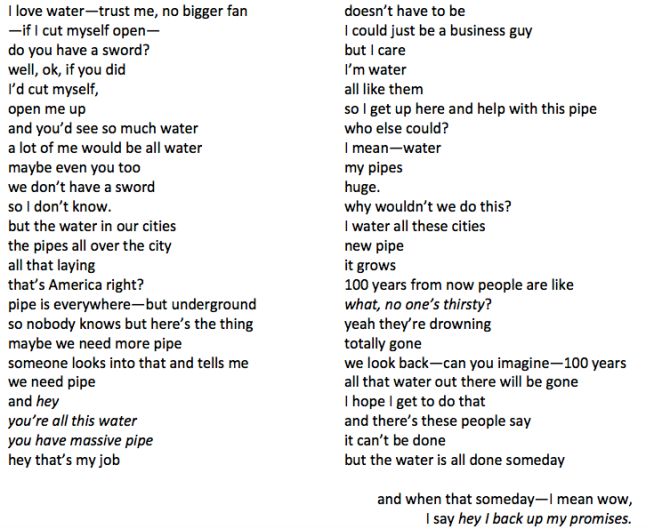
The Poetry Editor here at TeachPoet was able to get access to the poems considered to honor the immensity of the Inauguration, January 2017. In the end, no poet or poem was lucky enough to be performed that day. Here, we will publish the poems that were almost chosen for immortality, a resting place for only the best poems, believe me.


Last week, along with celebrating the wedding of my cousin and his bride in the Research Triangle of North Carolina, my family traveled from Raleigh to Wilmington, NC to visit the warship my grandfather served on during World War II (he’s top row, second from right in the photo). It made my grandfather’s legacy viscerally real for me to touch the work he did as a teenager. He and his four brothers were drafted or enlisted and all survived. Craziness. There is so much to say about this trip and I cannot wait to share these insights about this era and his generation with my students in the Spring when we cover those times. Thank you to the many Veterans of all ages, colors, creeds and conflicts.
Now though…
With this new election we are seeing the result of what happens when people feel empowered by their political leaders to draw a clear line between people who ‘win’ and people who ‘lose’. I think we’ve all lost. My Grandfather would be astounded by what we’ve been reduced to.
While I see and read about the tangible evidence of hate crimes and hate speech expressed under the cover of the 1st Amendment, I refuse to acknowledge that the majority or even a large minority of people who voted for Trump condone these actions. But he won.
So I’d like that subset of the population to ponder this…
As many people have pointed fingers at our Muslim communities around the Western World to police their communities for extremists, our white communities must do the same. Obviously, expecting Muslims to report of their shady neighbors is not a reasonable policy for myriad reasons, but the shoe is on the other foot now. What is the responsibility of white communities to police this divisive and vindictive behavior that calls us toward ruin?
Everyone has a role in stopping this train from derailing. Especially the winners.
What have our Veterans fought for, if nothing else?
My students are shocked and worried.
I am trying to take a step back for them so I can pause their fears of this new world. I promise them that we are better than this. That this election was not a referendum on their humanity. Part of me feels like I am lying to them. Part of me knows I am not.
My standing in society is secure no matter who wins elections. My students are not so lucky. I give voice to this, but my acknowledgement does nothing to change anything.
I’ve also been emphasizing that their work begins now. Nearly everyone in the Sophomore class and older can vote in 2018. From that standpoint, these results are inspirational. (I know, easy for me to say)
This is Freedom Work. You know it. It’s the work of being an American: Black communities have never stopped doing this work. Native American communities have never stopped the fight to survive in the face of tarnished treaties and being rounded up, surrounded.
White communities have fought too, often side-by-side everyone else. Standing against union-breaking and engaging with class issues and dreams of upward mobility are in everyone’s blood. From the Chinese Exclusion Act to now. From ghettoizing the Irish and Italians, how America treated its freedmen after the Civil War, how we gave life to the reservation systems, how women faced hatred in earning the right to vote. How these roots relate to now.
The Freedom Work, against all that does not liberate us, started as soon as Jefferson wrote all men are created equal.
Freedom in this country is not validated or erased by an election. It is ever-evolving. It is ephemeral. It is bloody. It is everyone’s. It can be understood from many angles.
But if someone else is not liberated, no one is.
Ask our Founding Fathers. Ask our Veterans.
A note to my family.
Many of us have been on the sidelines throughout this election. This decade.
Members of our family abstained from voting in this election because they couldn’t justify for either side. Others of us voted Trump, contorting into and out of and next to and removed from all the ideological and moral darkness we knew he stood for. Others no doubt protest voted third party. Others voted for a status quo that they knew wasn’t inclusive enough or meaningful enough. Our wide Irish net is a strong example of the wide spectrum of American white perspective.
Many of us have been still or silent on the work of Freedom for all. In this context, our family is not unique.
Let me reiterate: I think many of Trump’s voters, on at least some level, are also deeply disturbed that he won. I think that’s fair to say.
So, it’s time to join this work even if you voted for him. Whether you are Conservative, Green, Liberal, or otherwise. Get involved with stiff-arming hatred and misogyny by confronting it. Engage with communities that are not your own. Read books that are rooted in the many perspectives of Freedom Work. Pray with your spiritual community and outreach to a different one. Knowing 49% of people did not vote, get people to participate. However you want to engage, get to it!
After Tuesday (and truly no matter who won), inaction threatens the Democratic process and freedom for all.
Lots of Americans have been doing this work every damn day. Their life continually depends on it.
Now ours does too. Live accordingly. It’s an opportunity to create alongside your fellow Americans! How great is that?
With love and openness,
Your Son, Brother, Grandson, Nephew, Cousin, Uncle, Husband, Soon-to-be-Father
I want to be as inclusive as possible in this final section while knowing I’ve already turned many away from this post. For some it’s not enough – they’re right. For some I’ve gone to far – they’re not ready.
Saying that people across the electorate are dissatisfied with the entirety of this election is an insulting understatement to how misrepresented we all really are. I understand there are issues that will always divide us: marriage equality, economic policy, ongoing war. That’s encouraged! It’s healthy, dammit.
But.
If this Administration is so distasteful to so many people, and so many Conservatives specifically, we have a grand opportunity to build new movements against immorality, disenfranchisement, injustice, misogyny and complacency. What will this Administration do (or has already done?!) to our spiritual communities and selves? Our environment? Our shared sense of Americanness? Our sense of building a better world for our children and grandchildren? Our obligation to our sisters and brothers from across the country and world?
How do my questions intersect with your uncertainty?
The following is my new approach to the next four years.
How are we going to make America great again?
Not by violence. Not by hiding. Not by stoically watching it burn.
We are obliged by this election to make Trump’s legacy one of bringing people together from across the aisle and the country because a movement such as that, in a profound sense, will deconstruct the narratives employed by a majority of his campaign/pundits/cabinet/trolls about the falsehoods and shortcomings of shared identity and diversity in American classrooms, ideologies, communities, electorates, coalitions, protests, Freedom Work.
This obligation pushes back against any perceived mandate of this election (Congressional and Executive sweep) because what will emerge is a new American sense of principled and spiritual responsibility. No matter who won, this election was (re)purposed to destroy that shared sense of humanity. Because of who won, we will (re)build this shared sense of humanity passionately.
Creating this new American interdependence of communities, people, and agency will clarify the hate politics for those who willfully overlooked them in their 2016 vote (or non-vote) and it will be the antithesis of how this President and far too many within his base will want these years to be remembered.
This election does not depress, dissuade, end—it is the beginning, a thrust, our call. We are impelled.
We have no choice but every way forward—
—so that we continue the Freedom Work inherent to the opportunity of liberty and justice for all.
Proposed readings:
This post was inspired by my conversations, inspiration and reflection on these texts I have completed or queued up for this year and beyond. Buy yourself a Christmas present and boost that economy:

<>
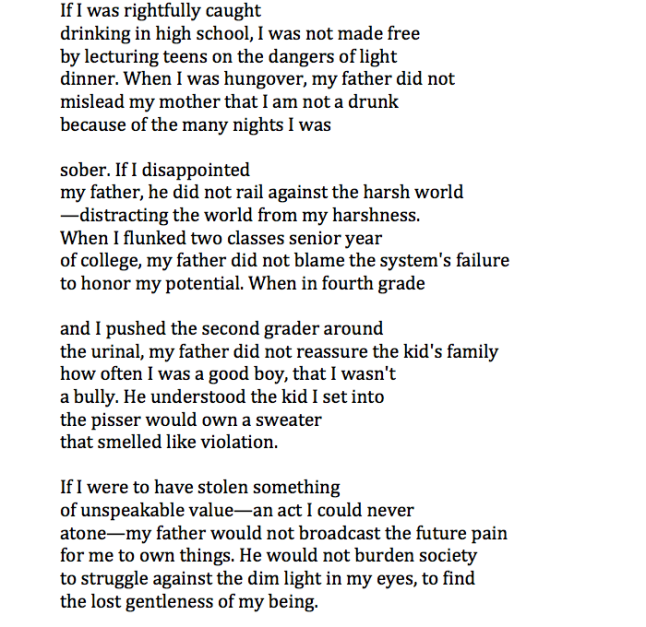
I offer this poem as a tribute to my father for holding me accountable for the transgressions that, along with the consequences, shaped the person I am today. I offer this as an imperfect, justice-seeking, frustrated-with-the-world white male. I offer this to the young men who are new to fatherhood.
I offer this to the reality of white privilege, that events like these can serve to level the playing field in our judicial system and how we parent/teach/exist. I offer this not to assert the self-importance of another privileged white male voice in the dialogue but to assert a new vantage point since privileged white males perpetuate these crimes, hear these cases, defend these clients, report on these cases, rear men capable of such terrible deeds, brush aside the power of these personhood contexts.
I offer this as an ally against our pervasive rape culture. I offer this to the high school and college students of America today to understand the severity of your casual thoughtlessness and violences. I offer this to parents who see their children as people who can do no wrong, even when they commit profound wrongs.
I offer this to the victims of sexual abuse and rape whose notions of manhood and power dynamics and personhood have been shattered. I offer this as an apology and acknowledgement of your pain. I offer this to those Americans who think this case has nothing to do with them. It does. All of us teach morality through our example. I offer this as a way forward.
<>
If you need to get caught up on the coverage, here are some links.
The victim’s intense letter to her rapist. Read aloud in court. I can’t imagine…
Dan A. Turner’s letter to the judge concerning his son’s new reality. This letter intentionally silences the violence, the victim, the chaos his son created choosing instead to focus on his son’s sterling reputation and promising future to this point. The title of this poem refers to Turner’s lament that his son’s appetite is disappearing.
And two artifacts to help us understand the role of language in naming, shaming or hiding our approach to sexual assault and rape. First, a video from Philip DeFranco on Facebook. Second, an annotated analysis of Dan Turner’s letter by Alyssa Peterson from Vox.
And finally, an important piece of media from CNN and an anchor who read aloud much of the victim’s letter to her rapist. Important coverage.
Vice President Joe Biden wrote the victim a letter. It is all over the Internet, but you can find it here.


A student in my world history class just insisted she failed my class last semester. I didn’t agree with her, went to my computer and hunted down last semester’s results. She didn’t do great, but she earned a low C. It would have been a D had she not earned an 82 on my Final. So? Whatevs.
Actually though, she didn’t insist. She just kind of shrugged. You think you failed?—teacher runs to computer to dispute her self-failure world view—see, you didn’t fail! Shrug again. So, cool right? You could do even better this semester. Whatevs.
This Studentbot is sure she fell short of the classroom standard. Why? Shrug, that’s why. Because you always fail classes? Shrug. Because your language deficiency makes it so you don’t know what’s expected or quality? Encogimiento de hombres. Maybe you never saw your final report card from last term? You never log into the computer software that helps students track this data? ¯\_(ツ)_/¯ Maybe you aren’t conscious?
It could be a matter of consciousness. Awake, sure, but they’re never really alive. You’ve seen them. Studentbots are the zombies queuing for mozzarella sticks or orange chicken or some other grease from the cafeteria. You know, brick wall meets cell structure and sentience in the science lab. Bouncing some sort of social Frogger between classes—find this person, avoid that clique, alms to the vending machine, swing by this bathroom mirror instead of that bathroom with the people in those mirrors, plug in for the soundtrack to manage their chaos and your cool, don’t go down that teacher’s hallway in case you need to ditch later.
The increasingly dull environment of school has created some ignorant sense of nihilism. It always has. I participated in it when I was that age. But we didn’t have dozens upon dozens of hours cozied up with a standardized test. These Studentbots don’t know if they are rebelling against their future or protesting the lack thereof. Or, they are trying really hard to prove they are not trying really hard. Socially it’s way better to be clueless than shooting for 90s; adversely, Alicia Silverstone was consciously ditzy while arguing her way to an A.

Another Studentbot this week was reviewing for an upcoming English quiz with a copy of that same quiz from 2014. I told her that seemed pretty shady considering that I know how deeply students struggle with that English class here in 2016. No—this was a studentbot insisting—I’m reviewing a quiz I took last week. That was a pretty fresh response. Not sassy. I mean fresh like some new fashion had hit the streets, like all of a sudden studentbots all over school review quizzes from last week—instead of like, you know, barely being cognizant of any academic deadlines otherwise. No, Mister! Reviewing-grades-that-I-can-no-longer-change-with-material-from-the-pre-Hotline-Bling-era is what’s up.
(Teacher note: That bullshit is some seriously misplaced nihilism. This wasn’t cheating for an upcoming assignment! This was not giving a fuck until there is nothing to give a fuck for! Way ahead of it’s time. I don’t always study, my friends, but when I do it’s already too late. The Internetati will look back on this moment and declare the Millennial generation dead. This is The Bot Generation. Do all things, but barely. Because, sure, it matters that I do well on stuff, but I can’t explain why stuff matters.)
I told her I was going to give her teacher the ancient assignment and leave it up to them. The Studentbot played it cool. A little talking under her breath. The ¯\_(ツ)_/¯ equivalent of a pout. She wasn’t about to let her guard down about something she so desperately didn’t care about.
But everybody knew. The teacher-in-question is the biggest hardass in the building. That makes her the most important individual in the building. She doesn’t take shit. Unfortunately, teacher-in-question knows the studentbot-in-question specializes in shit. This teacher was quite happy to give her a zero for the assignment. I walked away and to my lunch knowing didn’t care was about to turn into meant to care.
Next period, Studentbots’s friend knocks on my door and needs me in the hallway. I tell her one minute, but forget and she has to knock again. Apologetically I hustle into the hall and see studentbot-in-question holding back her IRL tears. Did you know teacher-in-question didn’t just give me one zero, but erased most of my assignments for the semester? Bummer. What can we do about it? I just want to know if that’s OK with you? Bummer, but I understand how we have no control over your consequence. So this this is OK with you? ¯\_(ツ)_/¯
The two students I have illustrated create interesting patterns of the 21st Century student. Student 1 is an ELL of Mexican-descent who can read English, but chooses not to. Student 2 is a Hispanic student who can read English, but only chooses to after she has to. Student 1 is a short girl with a normal body who is a little socially awkward, but seems to get enough attention from friends and boys to keep her sane. Student 2 is a cheerleader with an impossible slight frame who wears the type of clothing to accentuate that frame, attract attention and flabbergast the staff.
Student 1 has no understanding of how to pass a class, nor if she has or hasn’t. Student 2 has an innate sense of how to pass a class, and thinks she should be privileged in the execution of that how. Student 1 does not rely on anything to maintain her relationships with adults in the building because she has no relationships with adults at school. Student 2 leverages her athleticism and charms to work with the adults because she knows how to manipulate the world in her favor. Student 1 is in Guitar 1 and sometimes leaves her instrument in my classroom over the weekend. Student 2 is a two-time state champion with eyes on a third ring this April.
These women illustrate everything wrong with capital S school. People can’t be bothered to learn. Why does any of this matter? There’s a computer-based assessment with your name on it, that’s why. We are operating in a paradigm that has gone extinct, but teachnology has gussied it up enough to pawn it off on another generation. In their defense, sometimes my class sucks. Sometimes, I suck. Schools create sedentary citizens. Schools are places where creativity goes to die. Multiply that by four classes a day and you’ve got a pretty sucky day. I can sympathize. Until I can’t.
Because most days, we suck a lot less than they realize. They have teachers who are awesome. They have an incredibly clean (indeed, sometimes sterile) school. It’s safe. There are clubs and electives based upon, wait for it, classical art and mariachi and robots and metal fabrication and photography and drama and sports and green building and poetry and philosophy and forestry and other cool stuff.
Come on, Teach. Does it really matter if they cheat? Does it cost them anything to try? They actually learn more about the world when they cheat. Our whole existence is about getting that leg up on the competition. Where does it say we don’t have to earn our legs? And really, what’s the good in them knowing whether they passed or not? If the grades don’t matter, as you often insist they don’t to your students, why do you care if they know where they stand? High school is just a right of passage—it doesn’t have to be a means to an end. Saving face? Surviving? Sucking (it) up and sticking (it) out? That can be enough, right?
These are good questions. I am not trying to push my sense of (white male) morality/righteousness. Nor am I trying to push college (read: debt) onto my students. This isn’t Dangerous Minds or Freedom Writers. Rarely does a student change their academic horizon thanks to my tutelage. Honestly, they don’t. My students, the ones who have reached out after graduation, thank me for the support they had from me. Are they using commas correctly? Ha,ha right? Will they remember the profundity of the Treaty of Versailles? Yeah somebody won. It’s all I can do to even cover the subject in the face of this. There’s a name for the kind of teachers who sacrifice everything—personality, meaning, soul, facial expressions—sacrifice everything for plowing through content: Teachbots.
These students, Jennifer and Marissa, are great examples of how the education system and Teachbots have failed them for the last 11 years. At one time, this educational paradigm was perfect for churning out the next factory workers and management types—albeit largely white workers and types. Well, that world is gone. Teachers (and politicians) are the brontosauri waxing about a pre-comet planet. Few of the species adultus-worker lived to tell the tale, but the Teachbots insist to the Studentbots they are adequately prepared to exist in the same ol’ world. Let’s ground this paragraph in an example. We praise teachnology, but insist its best use is assessment.
Jennifer and Marissa are just like me (!). They know bullshit when they see it. But, between the three of us, I’m supposed to know what to do. I don’t. I have to predict the future. My crystal ball is telling me to subvert administration. Monkeywrench tests. Radicalize my paduans. Teach from the ceiling. Incorporate interpretive dance. Incorporate sadness and glee. Suffuse my classroom with oxygen. Actually? That last one is not a bad idea.
Jennifer and Marissa are suffocating just like me. So, the oxygen? Work to erase a decade’s worth of negative energy associated with classrooms. Push students for excellence, before work is due. Push students for excellence as demonstrated by meaningfulness of the work. Engage students in conversations about what it means to pass and fail—what it means to fail passing and pass failing. Insist that students are aware of their waking state. Insist that I am aware of my own.
Bots? Nah. We are brains. We are potential. We are everything. We matter. Really though, I can’t fault these girls for not realizing this. It’s how they were taught.
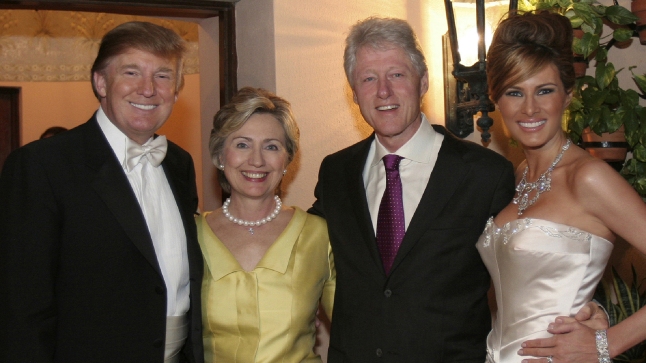
SCORCHING HOT TAKE DISCLAIMER- TeachPoet is not a political analyst. Consider the following blog post with the same grain of salt by which you are considering the value of this lovely picture of these humble Americans.
Gawd! That Saturday Night Live skit was funny. Or too close to home. Or horrendous. Or pandering. Whatever. It’s just…whatever.
I mean they captured Donald perfectly, right? He is a racist. Or, wait. Maybe he’s just playing to a racist crowd. Maybe he is the smartest guy in the room. Whatever. It’s just whatever. There’s no way he’ll win.
That’s the feeling I get from my students. Whatever. He’s a jackass. He’s a this. A that. They’re plugged into the political process now. They seek out John Oliver’s tele-editorialism. That’s cool. They might’ve heard about #BlackLivesMatter and #BlueLivesMatter and #AllLivesMatter now. That’s a step in the right direction; they have to take in many sides of any issue. In some ways Trump is exactly what we need. He’s the stark wake up call. My students realize at least that much.
But the media has a huge #BonerforTrump right now. It’s tremendous, I can assure you. I’m not referring to the televised media solely. New York Times, NPR, Slate, Esquire, Five Thirty Eight, Democracy Now, The Intercept, The Drudge Report, Breitbart. All of it. Largely I am thankful for the abundance of coverage; a Rubix Cube needs to be toyed with in order to solve it. But more and more, it feels like we are being trolled. Or scammed. Maybe we’re the jackasses. Maybe we’re the Rubix Cube!
The #BonerforTrump has obfuscated everything. Everything about his campaign and the political Dark Ages we find ourselves revisiting/entering. Trump sells, so we only hear his most virulent moments and not the hours of boring stumping his rallies usually look like. Trump excites/incites, so we consume his flashiest/crassiest turns of phrase. The #Boner has already won.
Yes. I hear you. It’s important to understand how he wants to reinstitute torture as a pillar of our foreign policy. It’s important that he has no foreign policy. It’s important to understand his rhetoric about immigrants and walls. It’s important to contextualize his jockeying to be the savior of the working American. It’s important to understand his juxtapositions are as much intentionally nuanced as they are blatantly obvious to create a level cognitive dissonance that can only be described as Trumpian. Maybe Americans are too lazy to parse through the farce?
It’s also important to understand what Cruz is selling us as the reasoned, positioned GOP candidate. I know! That’s crazy! It’s important to grapple with the rhetoric he is selling. It’s important to know a lot of all of this. Keep watching, reading, consuming.
Remain glued, America.
But, we have some serious blinders on right now. The thinking goes: If the Republican establishment, or Hillary, or Glenn Beck can discover his kryptonite in time for the general election, American values will be restored. It will go to show that we have not lost our minds. If we can just find a way to isolate the man, we’ll be fine. But, the #BonerforTrump isn’t going limp any time soon. There may not be any kryptonite.
His supporters, win or lose, are now politicized and engaged. They are voting like never before. The vicious, the vociferous, the vain have emerged from the shadows of the American electorate and are showing up en masse. Yeah, in some ways, it’s that simple. They are voting more than other political blocs. Maybe that’s temporary.
But we cannot disregard the vehemence and violence and vitriol this voting bloc foments. If #Boner wins, the marginalized and largely white audience will be vindicated in their passions for bigotry, celebrity, empty policy, free speech, free guns, greatness. That kind of mandate for a new president will be dangerous, we fear, for the entire world.
But let’s get honest with this bleak American political landscape. These Americans are not going to recede into their exurbs, insularity, whiteness after this election if he loses. His victories in Massachusetts, Virginia, Kentucky and Nevada exemplify this reality. This take back. Their worldview has already been validated.
Let’s play the If game.
If Trump wins, calm down. Won’t he get shutout by Congress? The political gridlock will continue even more than what Obama has endured. But, his rhetoric, in response to this stalemate and increasing ungreatness, will discover more scapegoats, more channels for voter frustration. Understand, if #Boner can’t achieve anything as President, it won’t be his fault. The anger that may put him in office will only increase.
If he loses this election, the voters who are fed up with career politicians and corruption aren’t going to take it in stride. What good is Hillary or Cruz going to do that will redirect our ungreatness? Imagine Trump running again in 2020 as the antidote to a four-year lame duck Executive. Even if he doesn’t run, the media isn’t going to stop covering his takedowns and insults of the person who wins come November.
The two-party system is on life support, if it even exists at all. Hillary is no more a Democrat than Trump is a Republican. The Democratic base is just as schizophrenic and wildly angry as the right side of the aisle. But, the media has not covered their fracture nearly as intently as the Republican side of the circus tent.
As much as anything this election demonstrates that America is the midst of the greatest con of all time. #Boner’s lack of policies and political acumen aren’t going to set up the next generation for a better America, but many Americans may not really care. And Hillary’s is a campaign that all but acknowledges 8 more years of a 21st Century status quo (endless war, pro-Corporate economics, a Machiavellian class of wealth and power controlling the coffers and the drones) as the lesser of two evils. The candidacy of the Left is an assurance that there will be nothing but gridlock. Think a Sanders White House is going to get anything done? This stalemate will perpetuate our infrastructurally unsound country. The ungreatness will abound.
Trump or not, this abundance of ungreatness will open the door to more scapegoating policies by future candidates. Don’t kid yourself. The next generation of politicians/entertainers/con artists are taking note of the excessive success of the #Boner campaign. In the future, it’ll get uglier. More platforms of racial divisiveness. More of the determinism that America needs leaders of strength and tenacity. Leaders who quash dissent. Who bully their own colleagues and citizens. Who dare the world to fuck with us.
When balancing our options in an election, sure, decency usually wins out. Yes, rationality, or something akin, unites us. But if there is one thing I am learning this election cycle, it’s that we’re participating in a game that no longer give points for decency and rationality. Those metrics are for pussies. And, we can’t forget, there are more people playing the game than ever before. Sure, they’ve always been able to play, but they preferred to jeer from the sidelines. Now they’re terrorizing the field of play. Louder and more incendiary. Angrier and less patient. More apt to gravitate toward candidates who say what’s on their mind than someone who says what’s actually believable.
So, let’s continue gobbling up the hysterics as if we’re simply binge watching Season 4 of House of Cards. It’s exciting to be watching something so brazen and alarming take place at political rallies and in our streets. It’s reassuring to know that no matter whom we elect, our children are no better off—because think of the possibilities for what’s to come next season! We won’t be making the world safer. And that’s entertaining too!
My students are going to be so lucky when they’re my age: Can you imagine what the 2024 season of #BonerForPresident will be like? I think I do. We’re gonna wish it was as benign as 2016 again.
Say it all ends tomorrow. Say I contract something nasty and can’t beat it. Say I say the wrong thing and can’t get ahead of the lawsuit against my license. Say I never show up again. Say I just disappear. How would I account for my last week of teaching? Would I look back with disdain? Regret? Accomplishment? Solace? Sadness? Relief?
In a Film class we watched Philadelphia. We witnessed a stirring performance by Tom Hanks wasting away. AIDS. 7:45-9:15 AM Monday and Wednesday. Homophobia. Opera. Discrimination. Mortality. Philly. I feel like these topics are important. Maybe wrong hour of the day but more than important. I feel like identity—who we are…creating…what we can do for the world—is something especially real for my students these days. If this was my last class, I’d be glad I made my students uncomfortable.
During 2nd Period on Tuesday, our school shut down regular class to boot up a practice test investigating whether our rural connectivity is ready for a week of PARCC testing in April. This is the second day in three weeks we have sacrificed an entire period on this issue, let alone the dozen or so student-hours devoted to testing since August and the next two-dozen ahead in April and May. Students log on and see how far they can get with the test. I’m the monkey dancing between tables troubleshooting and noting the issues. They are not supposed to breeze through the 24 question session; students should answer a question roughly every 3 minutes so we stay logged on long enough to measure if institutional readiness (not mastery-readiness). An hour crawls by on the back of a tortoise. If this were my last day of fake testing, I would die a full-filled teacher, filled with all the wrong things associated with education.
But during this fake test, I get to be a real person. I ask students about whether they have plans for a life post-graduation (yeah, it took me this long in the school year to be a real person). Most of them say college. Some have no idea what that word means for them: programs, NM or beyond, liberal arts (?), scholarships/debt. Some hope to be athletes. Some don’t know either way. I ask enough questions and have enough tortoise/time to know that none have deluded themselves into seeing college (let alone graduation) as something it is not. This process, watching students struggle or relish voicing their hopes and fears, is worth every moment of fake tests. I get to see them as young people with goals and dreams, not scores. Not data. Though, if this were it, I’d disappear a disappointed man. So many unanswered questions about some many undetermined destinies.
Today, I tested (more?!) my students on our 7-week unit connecting Reconstruction to Jim Crow and Civil Rights. I don’t remember learning about these US History topics within one unit. As a high schooler, I was never asked to connect the movements within the Civil Rights Era to the eject-button end of Reconstruction. I don’t remember learning that anti-miscegenation laws remained in ink on the Alabama Constitution until the 21st Century and how this law harkens back to the ugliness of Jim Crow: beyond the straight-line time and space of a textbook’s carefully curated reality. I wonder if teaching these periods disjointedly within the commonly accepted linear narrative of history is intentional. Is it easier to create ignorance when crucial narratives pause and pick back up every 10 chapters? Textbooks could rather be organized by thematic units: Immigration, Civil Rights, Foreign Policy, Boom and Bust. What my students learned, as evidenced by hard data, tells me we are learning correctly. If I never came back, they’d know we did something disruptive and subversive. Maybe, they’d know why I was gone.
On Tuesdays, a group of students from across the district come to my classroom to envision how Emotional Intelligence initiatives can support future students in our future schools. This hour-long weekly meeting went down as they usually do: quickly, inefficiently, with snacks. One senior led us through a team building exercise. Five balloons, five strips of tape, one tallest sculpture. Lots of popping. Lots of laughter. Lots of EQ-rooted shit talking. Lotsa sorta tall balloon creations. Did I say to build the tallest sculpture in the room, or just the tallest your own group can achieve? Was this a competition? Is it healthy for students like us to always interpret activities as competitive? Kid did a great job leading us. Sometimes, and considering the long-winded and meandering unnecessarily-circular-hyper-socially-aware dialoguing that usually pushes us well beyond an hour, popping balloons after a long day is the perfect way to cleanse my room of stagnant air. If this were all I had, I’d carry around with me a bag of balloons and a roll of tape for the rest of my life.
Oh, and this of course: Yesterday, we had to upload a plethora of documents for Observation. For most conversations around school among the staff, observation is not usually capitalized, but everyone carries an air like it should be. We belittle it in the same hour that we pour over our documentation and preparedness. So. I uploaded every teacher reflection I had written for my blog (I don’t post everything) to prove I was thinking about my practice. I threw a word document together with a bunch of curricular information to prove I think I know how to approach teaching. Pasted a screenshot of these digital attendance sheets correlated to those gridded grade books as evidence that I keep accurate records. I didn’t upload anything about how I engage in a professional community. I didn’t provide evidence how I implement professional development. After all, I’m aiming for a 3 out of 5. That 3 keeps the dreaded Professional Growth Plan at bay. I think I adequately cleared the artificial hurdle. It’s not that I refuse to engage professionally or pay attention during PD (though I fantasize about refusing both), but I—well if this was my last week, I’d rest knowing my work existed beyond metrics.
Say tomorrow, it all ends. Is it what you uploaded? Is it what you taught? How you taught? Would you mourn how calcified your disdain had become or the classroom joys you’ll never get back? Say tomorrow, it all ends. How would you help young people if you knew it was your last chance? Maybe they’d be better off if you disappeared. Maybe you’d deliver the instruction of a lifetime. Maybe, it’d be enough to do what you always do. Maybe it never is.
 Boy gets arrested for showing off a clock. What was the hot take from my Facebook feed and Twittersphere?
Texas, sheesh. Or. Of course, Texas. If that’s your ire, you may be missing the point.
Yeah, you’re not wrong. A police officer comes to the school to investigate, takes one look at the young man and says, “Yeah, that’s who I thought it was.” We all hope we don’t live in that community. We hope that kind of profiling and xenophobia exists, if it must at exist all, in faraway places. Ew, like Texas.
Yeah, there is a lot of this story to be disgusted by concerning this arrest and the Irving community at large. There’s also an opportunity to #standwithAhmed, as our President has done, or #trollforstoriesthatdonotserveus.
What I’m afraid of is how many other students are out there that don’t have the courage to share something authentic from their soul. Obviously, Ahmed is a pretty amazing little dude. And if he showed me that clock, I’d be flabbergasted. But I’d be inquisitive. What an opportunity to spend time with one of my students! And that’s the entry point for this post: For me, this issue hits a more nuanced chord than our pervasive, vitriolic Islamophobia.
With that in mind, let’s talk about MacArthur High. According to US News and World Report and using their statistics from 2012-2013, Ahmed must be one of 2,600+ students at this high school. He must be also one of nearly 1000 freshmen.
As well, if Ahmed continues attending MacArthur, he could expect to compete against the stereotypes borne of these statistics: 2/3 of the student population lives in poverty, nearly 85% of the student body is minority, more than half of the student population scores unsatisfactory on an English proficiency exam.
Ahmed, obviously, would have been tracked out of those classes where these language deficiencies can hold back entire classes and curricula. Ahmed was destined for MacArthur’s AP program. He would have beaten the statistics that often hold back our students of color in this country when it comes to the simple things like graduation.
I wonder, three weeks into the school year, how many adults in that school actually knew, or at least engaged, Ahmed. I wonder, with the reported 16:1 student-teacher ratio, what the sizes of his Freshmen classes really are. Any rooms with 30 kids, like my school and our 19:1 ratio? I notice from their calendar that there were at least three days of new teacher support for first year instructors, and another two days of professional development for the rest of staff. I wonder what staff reviewed and initiated in those days. If it was anything like the professional development in my district with presentations about differentiation geared toward the entire district or conversations about accountability and technology, staff attended begrudgingly and passively.
I’m afraid that Ahmed’s situation pulls back the curtain on everything that’s wrong with education in 21st Century America. I would make a pretty strong bet that none of the PD in Irving focused on relationship building with students. I would also go out on a limb and say that there aren’t many conversations happening in that school focused on supporting incoming freshmen.
This year, faced with teaching nearly 180 students in six classes, I used index cards to find out about my students. Within the first week, I had asked every student to fill out an index card to tell me what/if they read, what they do after school (even if that was only taking out the garbage), if they have Internet at home. Then, with my sophomores who all struggle to read and engage with class for more than ten consecutive minutes, I used a deeper survey to hear about what they’d like to learn about in World History, what their aspirations are for school, how I can help them better.
If I was to be lucky enough to have a student approach me with a FREAKING TINKERER’S PROJECT (!), I would have been prepared, at least slightly, to know engineering is an activity they enjoy. Shit, they’d be one of my few students (in the sophomore classes) that are engaged in any self-motivated activity aside from cruising the Taos Plaza or staring at snapchat.
Ahmed, who has shared with the world that he was bullied in middle school, was looking to create a relationship with his teachers. To put himself out into the world and hope he’d find some validation. Instead, cruelly, he was arrested. What a lesson. He was expecting his peer group to marginalize him for his being. Now he was finding out the teachers at his new school were quick to do the same.
It’s depressing, really. Teachers are not supported, encouraged, eager, courageous, curious, human enough to go beyond their initial reaction/impression with young people? Do too many of us succumb to this? Is it just a few? Are we turning into Teachbots who can only speak of evaluations, value-added measures, or accountability. I know I am frustrated in my community by how often the rhetoric in admin and teacher circles revolves around all the negativity associated with the job. Or the negate aspects of our students.
Mired in that negativity, we forgot that every classroom has an Ahmed in it, maybe even 30 of him. They are with us every day. But we’re operating in a classroom that is stuffed to the gills (5 of my 6 classes have more than 31 students). We are threatened to raise test scores and measure progress. We are pressured to report data and curriculum.
The darkest part of this story is that these teachers defaulted to Columbine and Sandy Hook than recognizing the shining, nerdy genius in front of them. Maybe they (grossly) defaulted to seeing him as an Islamist terrorist. I prefer to think they envisioned that first idea. And it’s weird these days. I have been subjected to a shooter drill where police officers come into the classroom and pretend to shoot all the students who haven’t hidden well enough. That’s scary shit. But the idea that a such macabre thought process would overcome an adult when confronted with a boy and his engineering project is crazy to me. But it’s also a sign of the times and how we all exist, perhaps nervously, within the education monolith.
From top to the bottom of this education industrial food chain, we’ve forgotten that you, Ahmed, are the reason we got into this gig in the first place. And supporting students like you, and myriad other overlooked kids, is a way to thwart the tragedies your teachers so feared.
We forget that teenagers are interesting little rascals. And they need to be seen. And they don’t get enough nurturing or encouragement from their world.
And some of them, like Ahmed, are way smarter. Or more creative. Or more fragile than even we teachers have been made by this education system.
Sorry, Ahmed. And sorry to the rest of the 2600 students at that school. I hope I’m honoring the 800 in my school.
 teachpoet