How to Remake the Ravaged

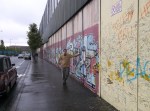
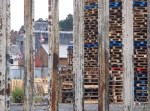
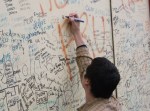
(Pictured above: Some good looking guy signing the Peace Wall. Read Peace Wall as an enormous divide between communities that signifies the safety now experienced in Belfast and how far these communities still must come.)

It is no exaggeration that Belfast was one of the most war torn areas of the late 20th Century. Local terrorist organizations sprang into action in response to escalating tensions between 1968-1971. The story here mirrors the story in Derry. But that city is a tiny hamlet compared to Belfast. Shove a million people into a rain cloud, some who bleed green and others for the queen, a football pitch’s worth of British tanks and troops, with an insatiable eye-for-an-eye mentality. You have 70s-90s Belfast.

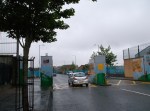
The violence was unparalleled. As Michael Rock (today’s tour guide) puts it, “If someone was killed on a Catholic Street by 10 AM, someone in a Protestant neighborhood would be dead by 12.” Everyone was a target. Walls were constructed to keep communities separate. Like any city aspiring to be the best, the walls had to be built higher and higher. You know, to deter the bricks, bottles, fireworks launched from landing  in their backyards.

It is obvious when you are in a Protestant Unionist community in Northern Ireland. Its vivid. The awnings and shops are blue and red. The streets are adorned with red, white and blue streamers, the light posts hoist the Union Jack. A couple reasons. The Queen’s jubliee (currently visiting Northern Ireland, Mr. McGuinness tomorrow). The marching season is amping up. Check out the pictures of the bonfire preparations!

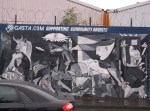
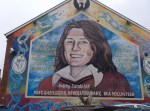
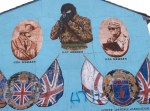
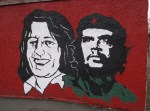
Each community has their murals. It seems the Catholic Nationalists made a concerted attempt to give their areas a face lift. The images are less violent. Their causes slightly more universal (read: Palestine). Their symbolism notably lacks gun wielding, masked gunmen. It seems like the Protestant Unionists are getting the message. Sandy Row’s murals are almost completely devoid of the violent imagery. Instead they tell a tale of the community’s working class heart.  But in the Shankill neighborhoods, along the Peace Wall yours truly is elegantly signing above, imagery of fallen UDA assassins still exists and some memorials are down right aggressively militaristic. When photographing one of them, a few children in this beat-down neighborhood shouted out: Everyday I’m UDA. They were holding beebee guns. They pointed them at the taxi as we toured their neighborhood. It is this sense of intimidation I will be trying to erase, in myself, as I walk through to Shankill tomorrow.
Also on the docket: A visit with Sean Montgomery and the Skegoneill-Glandore Community Center (where Protestant and Catholic communities meet) to see what connections can be made for the young when there is not an enormous Interface (Peace Wall) between them. And a walk to the Ardoyne part of the Catholic neighborhood, The Falls. There I will begin my relationship with the group recording and facilitating the Interface Diaries. Compelling and exciting to introduce to my students.

Family

I visited Strabane this weekend and had the great joy to meet the parents of Aidan McLaughlin. Our family hosted Aidan 17 years ago through project children. His parents are wonderful. Only one of their children live in the area. Aidan has moved to Liverpool almost seven years ago to make his life.

Strabane is a quiet town of mostly Catholics. Just across the River Finn is County Donegal. The South. The Republic. Ireland. In the past this would have been a heavily armored police checkpoint as border crossings have become from Texas to California. Within Strabane there are a few rougher neighborhoods moving up a bit, but still contain murals and painted lightposts to let you know the make up of its people.

Thirty miles west of Strabane is the birthplaces of both my great grandmother and great grandfather on my father’s mother’s side. Got that? My father’s grandparents are from northern Co. Donegal. A rough and rocky area. Bleak land as Pat McLaughlin called it. I loved it. Moving to the desolation of New Mexico made a lot more sense to me after seeing this area. Creeslough and Letterfad are separated by craggy vales and windy roads. Somehow my great grandparents left these tiny towns and met in America. I come from this improbability. Creeslough is big enough for maps and road signs. Letterfad, though marked on googlemaps, was unknown to the few people we asked along the road in two gas stations. These young people had never heard of it! Each time we asked, the area was less than five miles from them.

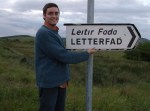
We made it to Creeslough and had a quick pint in the Log Cabin, complete with John Wayne images on the walls. The lady who owned it knew exactly what I was asking off and told us a general area on the north side of the road by which we entered Creeslough. We thanked her and headed back to Strabane. It was enough to have a Guinness in Creeslough. Driving back east, our heads craning to the left, looking for signs, for evidence of life in Letterfad. Pat made an insanely instinctual left turn at a near dirt road. We figured this would be about where to look. Lo and behold. The sign to Letterfad was off the post and tucked beneath the grass. It wasn’t pointing at much. But I’ll never forget the discovery. Next time I am in Ireland I know exactly where to go. There is a church and burial ground nearby which I can investigate next time. I hope my family is with me.

But this kind of magic describes what it was like to meet Pat and Margaret McLaughlin. They are sweet people with a great family, typical of the Irish heart and generosity. It was a great weekend. I am thankful for reconnecting these distant friends back into our lives. Enjoy the pictures. To be framed for sure!


This slideshow requires JavaScript.

A Final Post in the US

My trip is starting to take shape nicely. I have made hostel reservations for the next two nights in Dublin as I adjust to the time change and two days of flying. I will be lucky enough to share a night with Deonne Kahler and her mother. Deonne is a wonderful writing coach and woman from Taos, New Mexico as well. After checking into the Liffey, just a block away from the River of the same name and the Ha’ Penny Bridge, we’ll meet up for a bite and take in the Ireland Italy EuroCup tilt. It may not be a victory for the boys in green, but you can be sure of the celebration. Dublin will provide me with the chance to see Trinity College, the Ireland Writers House and find a hole-in-the-wall bookshop to purchase some poetry.

I have been researching and reading some modern Irish poets to gauge their take on the Troubles and begin to immerse myself in the artistic representation of this time in Irish history. Seamus Heaney is a poet of global renown. He is Derry born and selections from his first four books, especially Death of a Naturalist and North, have been with me for months. He captures the rural quiet of Ireland’s past in his early work and delicately grapples with the growing turbulence in Northern Ireland as the timeline of his work and the 70s intertwines. Another star of this time, though a bit younger, emerged from Belfast in 1948. Ciaran Carson’s work has been a revelation for me. I will be buying his books Belfast Confetti and The Irish for No if possible (use the link to hear the poet recite Belfast Confetti). Just as in our country, there are hundreds more poets more than worthy of mention, but that’ll do for now.

After my time in Dublin it will be time to really engage in the ethnographic study of my fellowship. I will take a train headed for Londonderry or Derry, depending on who you ask. I will be staying in a quaint spot within the Bogside and minutes from the world famous Mural Walk on Rossville Street. Waiting to hear a confirmation from the Bogside artists, but I hope to use these artists to dive into how legacy of the Troubles for Derry youth. Two days in Derry for now. But that’s as far as I’ll commit. Otherwise I’d like to allow for an organic experience and allow for opportunities to present themselves as I travel. I have no idea the wealth of expertise for my classroom I will meet until I meet them. So why build it up too much.

As I experience Dublin, I will look into a firm itinerary beyond Derry and into the weekend. I plan on arriving in Belfast Sunday night to extend the fellowship into the most war ravished city of the Troubles. Exciting stuff!

The Empty Seat

I wrote this piece on the plane from Houston to Philadelphia before I spent the evening with my parents. Traveling alone presents an opportunity for adventure and courageous daring (thanks, Josan), but is a reminder of how I live the majority of my life as a single chap in a small mountain town. Props to the grand slam poet from Derry, Seamus Heaney, as reading his work before I fell asleep most certainly influenced the cadence of my thoughts upon waking.

I woke from a nap
impossible to measure in minutes
or rest so high up
hoping I was surrounded
by something familiar, to be with
these stories I am
carrying in the messenger
bag and head, the stowaways
in my heart.

But waking in this hull of strangeness
the faces are just out of reach
like the drinkers on round two down
the row already loose on cabin pressure
and Absolute, the girl rising from the exit
seats fashionably emaciated and pierced lipped
like my students’ metal mouths and gaunt
exposed angles, that easy rapport between
attendants dancing up and down the aisle
always hovering. Next to me
the empty seat
I’ve always wanted to be an invitation
for someone to shatter the distance
and take them with me.

Cunning

There they are again
in the patchy grass handing cigarettes back and forth
reciting slams. Recognizing the world
for its rhyme scheme. Sure
they look like loiterers but that assumes
too little.

There is cunning and philosophy. What else
could they be
than wanderers on the hottest day, no means
to access the river?
The air conditioner in the public library has fritzed and
penniless for stores close in on them.

One day they’d have been apprentices and trades
for their fingers learning
to be smiths. But here
we raise poets
letting them smoke away on our lawns wallowing
in the void of culture. It is their American dream
to want nothing of their country but live unasked
and irresponsible.

They have learned our stories
and want no part in creating more.
Here we raise guerrillas.

teachpoet

teachpoet is an imperative. A path. A righteous call. I fear I do not write enough. I fear fear’s paralysis.

I am coming to know I am a teacher first. I have not developed a writing practice in the mornings before school. I teach. Then I write. My power is in the classroom. My voice is most impressive there. I write to channel those words into my poetry. Teaching is a juggling act fit for a man part court jester, part word wizard. Part parenting, part law enforcement. Part blah, part blah.

Ingenious and incendiary. Impossible and empowering. Thought challenging as much as thought provoking. Thoroughly selfless and humbling. Not the path to riches.

The transition between teacher and poet, therefore, comes naturally. If these are my aspirations in the classroom, so they are for my words. If I can shoulder any of these descriptions, I’d be honored and thankful.

Now back to work. A poet foremost.