It’s 20 Degrees in Taos

So I am thinking about the season of yard sales. Only because I am not skiing at Taos Ski Valley! Enjoy!

imgres

Estate Sale

I think of her salad mixer, the pea-yellow home furnishings, the nutcracker
on her cherry coffee table. She always had cream cheese and chives
for pretzels. Root beer in the latch refrigerator. Wearther’s in her pocket.
That run in her stocking. The corduroy khaki couch. The old room
with two single beds. The basement musk.
Thanksgiving dinner on a trampoline beneath the toothless-smile piano.

Her two-step stoop, watching my mother as a scraped-knee child,
then as a young girl with crushes, then
a young woman in a candy dress with Marlboroughs.
Picture frames of her children now. The endless gaze of her television.
The fur-lined winter jacket. Orthotic Velcro shoes. The journals
I wish she had written. Her translucent hands reaching for me
like a ghost. Like the lace sweater on a wheelchair
framing the entrance of the home, blank and locked.

Worms in the Classroom!!!

Yours truly is now a worm cultivator. And my students love learning about the worms! Check out some of their reflections in the comments section.

vghsfarmers's avatarvghsfarmers

image

Students have been learning about worms as soil creators. Read some of the comments to see what they have learned about farming this semester.

View original post

The Last Heave of Sun

Spent the day revising and revisioning poems for a prospective manuscript. A day of verse. Chilly. Gray. So for color:DSC00073

The Last Heave of Sun

Night reaches her purple hand across the table.
Daylight pulls away,
his clouds still out
pasturing around the mountains.
She a slight smile of crescent
whispers of Venus.

Despite the effort to regard their distance
his great wrinkles shade pink
and his eyes go papaya.

He cannot resist the emergence, her unfolding.

He gazes east again
careful to note the nuance
of her undress.

And so sighs the last heave of sun
settling into her.

She is the galaxy made bright by burning stars.

He a slow-lapped sand in love with an ocean.

Feast of Saint Tisquantum

sq

It has only been a few months since my last post. Time to send the silence to its reckoning. More to come…

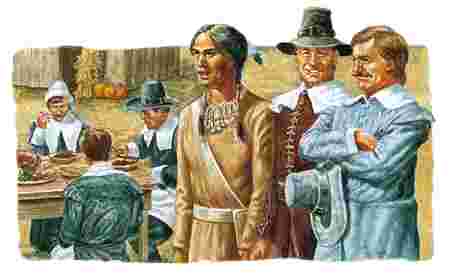
The Feast of Saint Tisquantum
as recollected from the glossy truths of American textbooks

Save his naked ghost a seat at your table amongst the cornucopia of roots and gooseberries
and the meat of musket shot. Commence with grace for the long-haired holy diplomat

and cultural chameleon. Remember the Wampanoag coast of rock and crash where black-suited exiles with buckled hats unloaded unprepared. Their seeds were not for this land, the fauna too

phenomenal. Their pilgrim hands unaccustomed to the labor of survival. Roanoke
then comes to mind, marooned and wasting away in colony. Imagine the Powhatans and

Tuscaroras watching from afar, patient for the sky to fall. Because white men had never come

to stay (!), they did not reach out. The exploration stalled and starved. Legend of colonial ruin traded north, up the coast in economy with shell and bead to the juts and boulders

of Tisquantum’s edge of the world where he was legend himself; tales twisted tall
of streets (streets!), ships, deities, slavery, his bilingual tongue. The clothing covered his legs

all year round, he thought the educated conjures of a salvaged savage who knew God
to be loving and just and warm. His soul had been saved (saved!). Only when he had returned

from the exotic longitudes of Malaga and London, his people had been decimated by bacteria.
As the pilgrims landed, psalmed, suffered and wavered, he did not tirade or shake the war rattle (!).

He taught them viable crops and fertilizers for a flourishing. In their quest to find God’s many faces
within forest apparitions, the bounty of New World anarchy, of Indian and frontier,

Squanto was a docent of wilderness. __ __ __ __ __ __ __ And in the end thanks was given for a harvest
and togetherness. God was present on the shoulders of his saint. Give thanks unto him,

patron saint of squash blossoms and potlucks. The rest are simple footnotes
and iniquitous blemishes (!) to be misremembered or forgotten. But not the doted Patuxet,

this salvaged species, there is responsibility at every table to revere the naked ghost,
rightly stripped to a favorable likeness for the voracious cavalcade of football and feast.

Send an Artist Back to School!

I had some students help me create a video for a fundraising campaign. We are hoping to create something of an artist-in-residence program at Taos, but with multiple art classes happening every Friday afternoon for ALL students! We are trying to raise 30,000 American Dollars to help compensate the artists for their time.

This could be a once in a lifetime experience for many of these students! Check out or video and SHARE SHARE SHARE!

VGHS Red Capes Pitch

Tightroping Motivation

I have been toying with writing about my life as a teacher for some time. Prior to the censored poetry issue, I was already on my way penning drafts of essays and poems. I am ready to release them into the ether. Here’s one about purpose, motivation and leading with the heart.

People need to find and understand the purpose of what they are trying to accomplish. And students today have, arguably, lost their purpose. What’s next after high school? Anything reliable? Anything definite? No? Well, then what is the point?

As a teacher you have to find ways of motivating your students. You can be sincere and thoughtful. Matter of fact. Prodding and pleading with Jeremiads. Heartfelt and empathetic. Or you can be blunt and borderline mean. But your personality and approach far outweighs the message sometimes. So how do we create students who are on fire about education?

Thankfully there is a boatload of purpose embedded in our Expeditionary Learning curriculum. We study Border Issues and interview members of Taos about cultural divides lingering in our town since colonialism, both Spanish and American. We ask ourselves of community needs and argue publicly for those needs with editorials. We learn of the heroic journey, and Plato’s account of Socrates’ reasoning for his life, and write our own apologies. This is stake in our studies. There is purpose. Once that line is blurred or forgotten, the students are remiss in the duty of learning. As if there needed to be something more than the simple act of learning.

For many, the topic of our Expedition is a moot point. Students may never buy in. They may never do an ounce of work outside the building. But with Expeditionary Learning there must be a need to know. More than desire. A burning, on a Maslovian level. My future depends, somehow, on this learning. I need to know how to build soil, how to introspect, how to spend my money as a consumer, what messages or affirmations or cries for help I can embed in my art. The skills of citizenship.

Pubescent teenagers rarely demonstrate this level of internal drive or pride in their work. For most teenagers, this is a time of fumbling around love, social awkwardness and acne. Dealing with off base parents. Scoring the next high. Few truly want to do good or make change. And so purpose is the push they need. Addressing community issues. Or building something bigger than themselves.

And as a young idealist, this was enough for me. If my students could achieve  within the context of my high stakes project experience, this accomplishment, often measured beyond the constructs of English class and the drudgery of school, was enough for me to deem them ready-for-life-after-high-school. I didn’t give work based upon rigorous reading comprehension or traditional assessments. Old school skill sets. My philosophical standpoint and world-view regarded these as antiquated, misinformed data points. I had of my students, and their world, more holistic views. More heart based. More human oriented.

But I was limiting them. I am not sure I bumped one student from not passing to proficient on the state tests with this approach. I would argue that most students who passed these tests could have done so with or without me as their teacher. Those students, in my first years, who couldn’t pass as a 9th grader, likely wouldn’t pass as an 11th grader. What I was teaching, although engaging, practical and important, was not in the traditional metrics of success. And whether Common Core State Standards is here to stay is not important. The tests open or close the doors. If they cannot pass the state tests, they are not passing the ACT. If they are not passing the ACT, I am not helping them entertain success in college, let alone enrollment.

But my practice was not being questioned. I am looked at as a senior member of our faculty. I am an Instructional Guide. I am sought after by my peers. I have been accepted as a Master Class presenter for Expeditionary Learning’s National Conference three times. I have been invited to share my curricular work with a national audience through Fund For Teachers and my two traveling Fellowships. But my kids don’t do homework. In fact, I rarely assign homework. I intend for rigorous in-class experiences and assignments. They very well may be. But my students are not making gains. Of course, I am not alone. Despite my accolades and the esteem my colleagues may hold for me, I am churning our students much like the rest of the state’s educators. Those students are unable to enter a college class beyond the remedial level. And students who enter college in remedial classes rarely have the wherewithal, motivation or support to graduate. Those who I am unleashing into the world with dreams may be rudely awakened without apology.

So I can encourage, plead, bargain, bend backward, massage, and finesse earning high marks, but I cannot ensure participation. Nor desire. And certainly not purpose. And in the past, this would be fine. Students could skirt by in high school towards a diploma and take a couple classes at UNM Taos without much consequence. But in this climate of testing, New Mexico is upping the ante for potential graduates. Trying to keep up nationally, if one cannot pass the tests as a Junior, the student may never earn a full high school diploma. Or they can demonstrate mastery on an End of Course Exam created at the state level. Essentially, can’t pass the test? Well, make sure you pass the highly correlative Final.  The access to a full high school diploma is all but fantasy for some students, if you were to ask them. The likelihood this will only result in more post secondary confusion and dropouts is certain. Oh, I cannot earn a diploma, and you have evidence of this by the time I am a freshman, but I can study for a few months and possibly earn a GED? Perfect. Bye!

Sometimes a teacher needs to be real. Too often we are not. The harsh realities of these tests, and the students’ disbelief in both their aptitude and the tests’ efficacy result in a complete malaise that becomes infectious. The culture of education is demeaned and learning loses value. School becomes a social event solely. Students’ negative view of world and self are reinforced. The teachers are left on lonely islands without purpose or meaningful appreciation. A life alone with only your shaky nerves and graying hair. Isn’t that the movies? Isn’t that the state of our education unions? Tenured and safe, but downtrodden? Too few exceptions.

So I tell my students about stereotypes. I tell them that the average reading level of an incoming VGHS student is the fifth grade. Those ill-equipped readers are likely to drop out. 80% of our student body qualifies for free and reduced lunches. They’re poor. Those students usually do not graduate. Hispanic males, Native American women, children from broken homes are not meant to go on and succeed in college. 4.0 for a student like you? Out of the question. Academic scholarships? Forget it. Likelihood of a job with benefits, paid vacation, retirement plan? Not on the horizon without your high school diploma. The numbers never lie. You aren’t going to do this and you most certainly aren’t going to do that. You aren’t smart enough for this school, you aren’t educated enough for this job.

All the stereotypes about my students are being fulfilled. The correlation between teen alcohol abuse and literacy. Check. The relation between skin color and graduation rates. Check. My students are smoking pot more often, I’d say three to four times as much, than they touch a book. My students are so hungover Monday morning my classroom’s florescent bulbs are still a bother Tuesday afternoon.

And so I say: You tell me how unfair it is to misjudge you. How many people limit your with their preconceived notions. Might you know why there are college in the Southwest with free tuition for college bound Native Americans? Or why UNM offers a lottery scholarship for graduating high school with a 3.0 pulse? No one thinks you’ll go! No one expects you to follow through and educate yourself! No one expects you to be anything more than a 20 year old mother. A deadbeat dad. Another drunk Indian. Another domestic abuser. Another statistic fulfilled. Another stereotype met to justify correlating literacy levels and available beds in prison. You are cementing the same stereotypes for your younger brothers and cousins. Your children. You are not besting or outsmarting the cruel world you perceive with your strategy of avoidance. You are succumbing! The only person establishing your future is yourself. But a statistic, or a stereotype, cannot make decisions.

And then there is either applause or awkward shifts in desks. Followed by sheepish questions trying to convince themselves, and more importantly me, that they are ready to get after it and give their best effort. For at least today’s lesson. I’ll do it for the Gipper this once.

But I would have to deliver this sermon weekly to keep the students lit. I cannot say mush. I must only show up. Ready to drop knowledge at any moment. But these speeches, or diatribes, or moments of sheer panic, depending on the audience, day, or mood, cannot be overused. I never get angry at a student publicly. I never raise my voice save once a year. These moments need to be unpredictable, unscripted and highly emotional. I find my voice quivering by the end. And I never know how a teenager will react when I tell them to prepare for a life of alcoholism. I believe this scenario could be an alternate future of the phrase don’t kill the messenger.

Bottom line. Motivating students in this day and age, in this town, is a tall order. I am happy to facilitate cool and innovative project models and bring opportunity into the classroom. I am also happy to not assign homework both for the rigor of my class time and the advocates it creates of my students. I don’t think anyone has told them before how hard it is going to be to defy stereotypes. I am not sure they know that anything intellectually grueling is worth a moment of their time. Few witness this at school. Fewer see this demonstrated at home.

Maybe it is all about setting a new purpose. A fresh target. Something they can all aim for. Something written in student-friendly language. An I can statement. Something to build self-efficacy:

I can defy my stereotype.

OK, class. Who can tell me what it means to defy.

Standardized Testing Poetry

Last week I had posted a brief collection of poetry that I thought was benign. Those poems, with references to the tests my students are tasked with mastering each spring, were removed at the encouragement from school administration. My poetry had jeopardized the validity of my students’ scores and asserted a dangerous point of view in terms of my professionalism and requirements of being a teacher in handling the sensitive test information.

I am mulling the decision to repost these poems and the consequences this act may have for my licensure. I believe the poems stand as a critique of our testing culture and the realities facing our students in this education paradigm. The fact these poems could be seen as a threat to my students’ scores or my professional integrity only reinforces the need for a look in the mirror with this testing climate we live in as educators and students. Can my poems, with direct correlation to the tests, really be so dangerous? Am I not allowed to critically think about my experiences as an educator and interpret them poetically? Do my words about tests and the frivolity of the tests outweigh my references to disillusioned youth, school massacres/murderers and the everyday grappling with apathy and boredom? I would think mentioning Klebold, Harris and Lanza would be more of an alarm than addressing testing issues.

As I try to personally come to a conclusion about these issues, I offer two more poems written form my experiences last week. In response to my poetry, I am no longer allowed to proctor tests at Vista Grande. That doesn’t mean I cannot critique and, more importantly, feel.

Grammar Teacher’s Doubt
Has the comma dislodged
from an isolated brain wrinkle
finding roots within the written response?

When I said run-on sentence
and they said huh?
did it matter how I responded?

If I were explaining poetry again
to a crowd of texters and tweeters
would they finally see themselves
as poets
creators of lines
affronters of language?

Do they remember what I have spoken
of their voice
that their song can move mountains
and today’s audience is aptitude?

Gaps Akin to Achievement
One exists with nutrition
the abyss between my students’ McDonald’s
and those students’ whole foods

There’s one with stability
the great equalizer is home
perhaps the heat, the divorce, the abuse

Purpose—the great unknown of growing old
and whether this test is any measure
of anything on which to rely moving forward

Bringing the Changes in Belfast to Taos!

Alan Waite is a youth worker in the Shankill, where the parade took place last Saturday and the ominous mural of the gunman pointing his rifle right into your grill never sleeps.

He is a lifelong resident of the Shankill and knows the ins and outs of his community. The lies. The power structure. The reality for the youth. I learned of his work from the Interface Diaries, but his reach in the community does not stop there. The scope of his work is impressive and inspiring. What was meant to be a brief meeting at a coffee shop ended up as a three hour sharing of ideas, project models and curricular ideas to connect our students and augment each other’s work with young people.

I wanted to know about what the youth see as their future. He says it is bleak. Very much like my students, they react to their boredom with anti-social behavior. I love that phrase: anti-social behavior. The savvy and debate prone students of mine would argue that this type of behavior is quite social. Drugs and alcohol. Teen pregnancies. Paramilitary organizations (think the UVF and UDA) operating like street gangs. Sounds like a party atmosphere to most bored teens. And even if they can navigate this minefield, there are few long term employment opportunities for Belfast youth in any neighborhood. Alan’s mission, along the rest of the dedicated staff at Glencairn Youth Initiative, is to create opportunities for these young people to serve their community.

They have developed YWIC. Youth Workers in Communities. This initiative is made up of a three year cycle for young recruits. In year one, young people with leadership potential have been identified. In Alan’s eyes this doesn’t mean straight As, straight faced or straight laced. He’s actively seeking young people that are street savvy and hold sway with their peers. Most people call them rabble-rousers. Alan likes their moxie. So does Vista Grande!

These identified youth take part in a 5 day residential experience with 40 peers. They learn about the different types of leadership the program offers. Leadership during these types of experiences. Sports leadership in the community. And peer mentoring leadership. The youth have a chance to plug right in upon returning to their neighborhoods.

In year two, these leaders do more street based work. Interaction with their community. Hands on. Map work and statistics. Identifying needs and strategies. They run the night programs for the year ones after their residential experience.

At year three of this cycle, these leaders are ready to work alongside Alan and the team for an 8 week work cycle. And with the mix of skills they have from throughout the previous two years they are true assets to their community. Also these young people are certified youth workers. But the job opportunities are still few in this field. So Alan sees the issue of training and cranking out twenty people are years as this program gains traction with nowhere for them to work. But at least it has instilled the tradition of community volunteerism. The peace process had changed that as now there was money for jobs and people in the Shankill know they can get paid for certain work. Volunteerism is so pre-peace process.

Another challenge to this type of work in the Shankill is generational and community perceptions. Alan sees most young people as having zero cultural awareness. Why do you have parades and bonfires on July 12th? To have a party in the summertime! Why do you hate people in the Ardoyne? I don’t know! Like most people finding their way in a complex world, they simply celebrate and regurgitate. Alan remembers his grandmother singing UDA songs to him and his siblings. Often referring to the people in the Falls as Feinian bastards.

The community perception of life in the Shankill is a bit more dear. These areas are governed, still, by the paramilitaries. This links back to my piece on the Politics of Image. The UVF and UDA have been trying to elbow their way into the youth work money game. The peace process, as also noted previously, has infused monies into hungry communities. Instead of these funds heading towards proper organizations, the paramilitaries are getting the money. Restorative Justice is one such opportunity to force kids into the process and then use this platform to ‘take care’ of them after the fact. This also is an indicator as to why the violent murals are maintained in the Shankill. Everyone knows who is still in charge.

Nevertheless, Alan and I are conjuring up ways to get our students and youth workers together. Much like the Interface Diaries or something akin, via Skype, my students can interact with these youth workers when they meet for their night groups as our time is seven hours behind. They meet at half six and we are just beginning lunch. This is the opportunity I’ve been looking for.

Using their resources, like Shakespeare Unplugged which pits that age old tale in the heart of the Shankill to illuminate intra-community divides, I think my students will be inspired and challenged to see themselves in the midst of community divisions and generational prejudice. More to come with this development. But today’s meeting will have the most profound impact on my borders curriculum. And an enormous influence on my students. It’s grand, isn’t it!

The Politics of Image

As mentioned before I have been walking by and through the Sandy Row neighborhood throughout the last ten days taking stock, exploring and pondering. The streets, like all Protestant Unionist neighborhoods, are decked with Union Jacks and the three colors of loyalism bunting crossing the sky. Sandy Row is infamous for its balaclava-donned UVF gunman solemnly welcoming you to the neighborhood. The wording is very much like the commemorative wall in the Bogside. Welcome to Free Derry.

The push is on all over Belfast to remake the terrorist imagery on the broadsides of buildings in a less villianistic proportion. The Catholic neighborhoods have been effective in this process. They have turned their messages to acknowledge similar leftist social justice causes around the globe. Guernica. The politically disenfranchised Cuban population. Palestine. Global warming in the developing world.

When communicating their own history, murals have turned into their story of struggle or celebrating their cause for political standing in the North. The potato famine. The Falls Curfew in 1970. Gaelic sports like hurling and football.

I have noticed the political cohesion in Catholic Republican neighborhoods. Most people have told me I am spot on. Historically Sinn Fein and the IRA have had a cozy relationship. In most cases during the Troubles, the IRA simply carried out the guerilla war agenda of the Republican ideal. Sinn Fein worked the on the political side of things. Once seen as a radical left political party, Sinn Fein has gained seats in Stormont and momentum as the party of the people in Northern Ireland ever since Hunger Striker Bobby Sands won an election while in prison. Almost every neighborhood in Belfast has a Sinn Fein office. The tie between the people and the party is apparent and this has helped Sinn Fein establish itself the voice of the working class and poor.

Not long ago the murals in Catholic neighborhoods were also branded with a terrorist feel. Gunmen peering through balaclavas was not unique to Sandy Row or the Shankill. But the face of this public artwork has changed to reflect the people, not the war. It is a manner of distancing themselves politically and morally from an ugly conflict with its impossible victories. This push has been made easier as the IRA has lost its grip of violence on the neighborhoods and Sinn Fein can act as the moral safeguard.

In Protestant Unionist communities, the Democratic Unionist Party (DUP) and the Ulster Unionist Party (UUP) have existed since the beginning of political separation of Ireland and Northern Ireland in 1921. Politically, these two parties have shared votes, voices and neighborhoods in these areas. Coincidentally, the Ulster Defense Alliance (UDA) and the Ulster Volunteer Fighters (UVF) took up arms as neighborhood defense regiments during the Troubles. So politically and militarily, neighborhoods like the Shankill have been divided along these lines. And in the choppy wake of the Troubles, the political mouthpieces advocating for these areas have not been as effective in galvanizing a community wide vision for these areas in the way Sinn Fein has. Especially when it comes to the artwork.

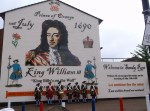
On Monday though, a major hurdle had been cleared for the Sandy Row. At the community unveiling one speaker noted that tourists would walk across the Boyne Bridge to snap a photo of the mural’s sinister welcome and turn away from the shops lining Sandy Row. This is an opportunity to regenerate the mural itself but also the community in connecting the history of King Billy to the present. It is noted in history that King Billy marched with his troops through Sandy Row on his way to the Battle of the Boyne. Therefore the image of their beloved King is not just an artistic gesture. It is the story of the neighborhood.

The mural captures the famous quote King Billy had for his young troops that day. “Let ambition fire thy mind.” For the Sandy Row, this ambition is to cling onto the caboose of the financial train Belfast is becoming. The city is attracting tourists like never before. Well, because no one had ever come to Belfast aside from war correspondents from 1970-1998. So in the last fifteen years, along with the cherished peace money flooding war ravaged neighborhoods, the financial impact of touring these notoriously paramilitary-haunted neighborhoods has regenerated places tourists had never been even before the Troubles.

The press was there to see it. The community celebrated with tea and scones. And at 10 AM on a Monday teenagers were nowhere to be found.

The North Coast

Not much to say at the moment aside from letting you bask in the beauty Mike and I witnessed on the Antrim Coast. Pretty spectacular. I’ll try to write more at some point about the history, the scenery and the power. But for now, just enjoy the pictures! Incredible day. Notice how wonderfully blue the sky can be in Ireland. It didn’t happen much while I was here. But when it did, man was it spectacular.